LCD vs VA High-Definition Screen for Thermostats: Power Consumption & Display Quality Differences
Leave a message
When choosing a smart thermostat, most homeowners and HVAC installers focus on core functions like temperature accuracy, smart connectivity, and energy-saving modes. However, the display screen type is an often-overlooked factor that directly impacts daily usability, battery life, and long-term user experience. Traditional LCD screens and modern VA high-definition screens are the two dominant display options for residential and commercial thermostats. Their differences in power consumption and visual performance create a huge gap in device durability and user satisfaction. Today, we break down the core distinctions to help you pick the perfect thermostat screen solution for your needs.
1. Power Consumption: Long-Term Energy Efficiency Battle
Power consumption is critical for thermostats, especially battery-powered wireless models, as it determines charging frequency and service life. Wired wall-mounted thermostats also benefit from low-power screens to reduce long-term operational energy costs.
Traditional LCD Screens: Ultra-Low Power, Ideal for Continuous Standby
Conventional segment LCD screens adopted by most basic thermostats feature a simple passive backlight structure and mature technology. They only consume tiny power to drive liquid crystal rotation and basic backlight lighting, with almost no extra power loss during static display. Since thermostat data (temperature, humidity, working mode) does not change frequently, LCD screens maintain extremely low average power consumption in long-term static standby status.
This advantage makes LCD thermostats stand out in battery-powered scenarios. They can support 6–12 months of battery life with ordinary dry batteries, requiring minimal maintenance. The only drawback is that traditional LCD screens cannot support high-definition dynamic display, so they are limited to simple text and number display.
VA HD Screens: Slightly Higher Power, Optimized for Smart Scenarios
VA high-definition screens adopt advanced vertical alignment panel technology with richer pixel display capabilities. Compared with traditional LCDs, their overall power consumption is moderately higher, mainly due to the high-precision backlight module and full-pixel driving system. For low-frequency static display, VA screens consume more power than ordinary LCDs, which means battery-powered VA thermostats need more frequent charging or higher-capacity batteries.
Nevertheless, modern VA screens have achieved effective power optimization. For wired smart thermostats that work stably for a long time, the slight increase in power consumption is negligible, while the upgraded display experience far compensates for the tiny energy cost. It is a worthwhile trade-off for high-end smart home devices.
2. Display Quality: Visual Experience Gap That Cannot Be Ignored
As the interactive window between users and the HVAC system, the thermostat screen's clarity, color restoration, viewing angle, and anti-glare performance directly affect daily operation convenience. The display gap between LCD and VA screens is more intuitive than power consumption differences.
Traditional LCD Screens: Practical but Limited Visual Performance
Ordinary LCD thermostat screens are designed for cost-effectiveness and basic practicality. They mainly display black and white or simple blue-green monochrome content with single color layering and low resolution. In terms of contrast, traditional LCDs struggle to present pure black backgrounds, resulting in overall grayish and flat screen performance.
In addition, LCD screens have narrow viewing angles. When users view the thermostat from side or oblique angles (common in living rooms, offices, and bedrooms), the screen will have obvious color fading, brightness attenuation, and blurred text. Moreover, they perform poorly in strong indoor light, prone to reflection and unclear content recognition, which brings inconvenience to daily temperature checking and mode adjustment.
VA HD Screens: Immersive High-Definition Visual Experience
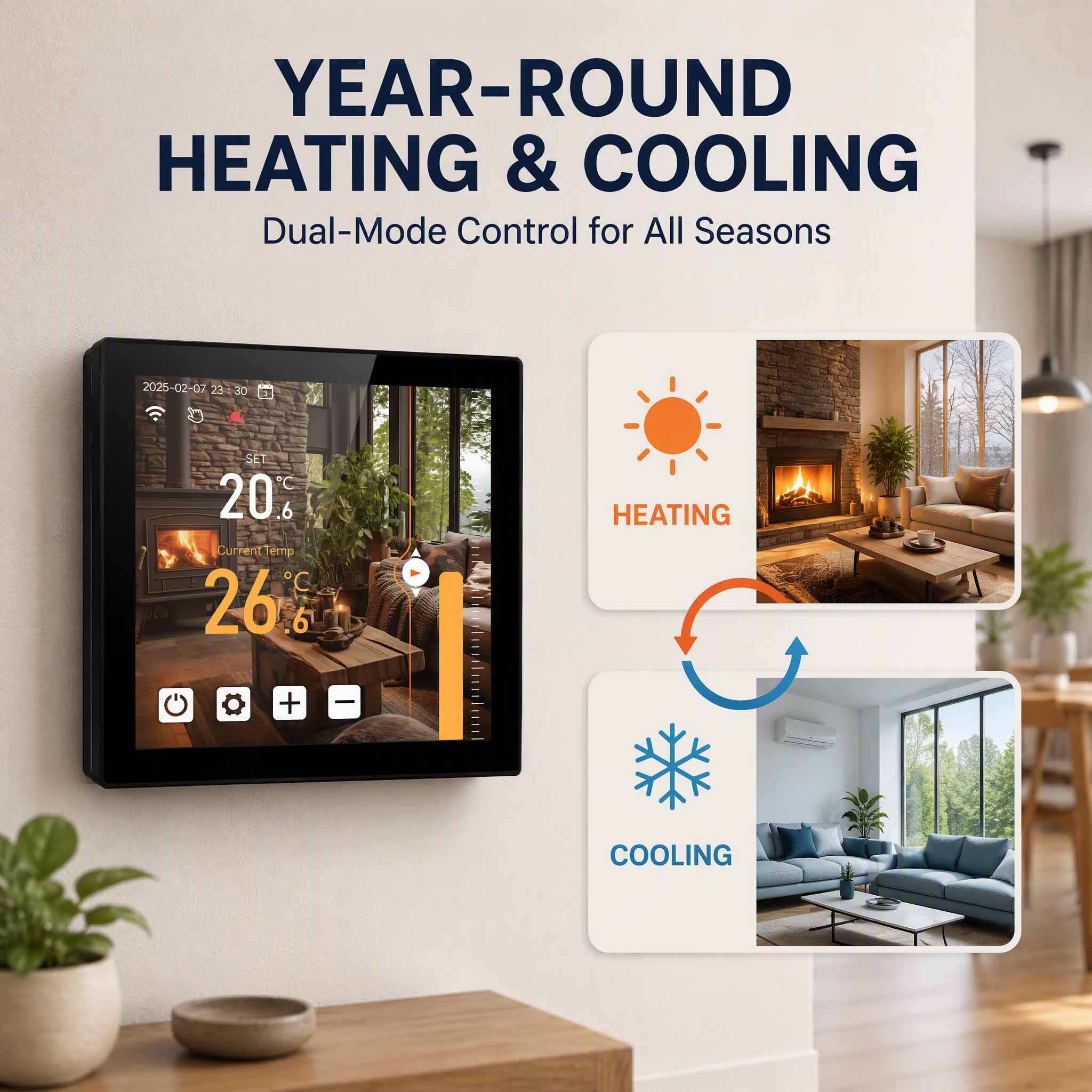
VA panels are famous for ultra-high contrast and excellent color layering, which is a revolutionary upgrade for thermostat display. VA screens can present pure black backgrounds and bright and delicate color details, clearly distinguishing temperature values, working modes, timing icons, and smart linkage indicators. The screen content is layered and three-dimensional, completely solving the gray and dull problem of traditional LCD screens.
In terms of viewing angles, VA screens far surpass ordinary LCDs. With a wide viewing angle close to 170°, users can view clear and undistorted screen content from any front or side position without color shift or blurring. Equipped with professional anti-glare coating, VA HD screens also adapt to complex indoor light environments, maintaining high visibility whether in bright sunlight or soft night light.
More importantly, VA HD screens support dynamic screen display, customized screensavers, and multi-color gradient presentation, perfectly matching the intelligent and high-end positioning of modern smart thermostats, upgrading the overall home decoration texture and user interactive experience.
3. Scenario Recommendation: Which Screen Should You Choose?
After comparing power consumption and display effects, we can quickly lock the most suitable screen solution according to usage scenarios:
Choose Traditional LCD Screens: Ideal for budget-friendly basic thermostats, battery-powered portable thermostats, and simple commercial HVAC control equipment. They prioritize low power consumption, stable operation, and low maintenance costs, fully meeting basic temperature display and adjustment needs.
Choose VA HD Screens: Perfect for high-end smart home thermostats, wired wall-mounted intelligent thermostats, and commercial office intelligent temperature control devices. They pursue exquisite display effects, diverse interactive functions, and high-grade appearance, and tolerate slight power consumption increases for a premium user experience.
Final Verdict
There is no absolute good or bad between LCD and VA HD screens for thermostats, only suitability for different demands. Traditional LCD screens win with ultra-low power consumption and high cost performance, being the best choice for basic and long standby scenarios. VA high-definition screens lead with high contrast, wide viewing angle, delicate colors, and strong environmental adaptability, becoming the standard configuration for modern high-end smart thermostats.