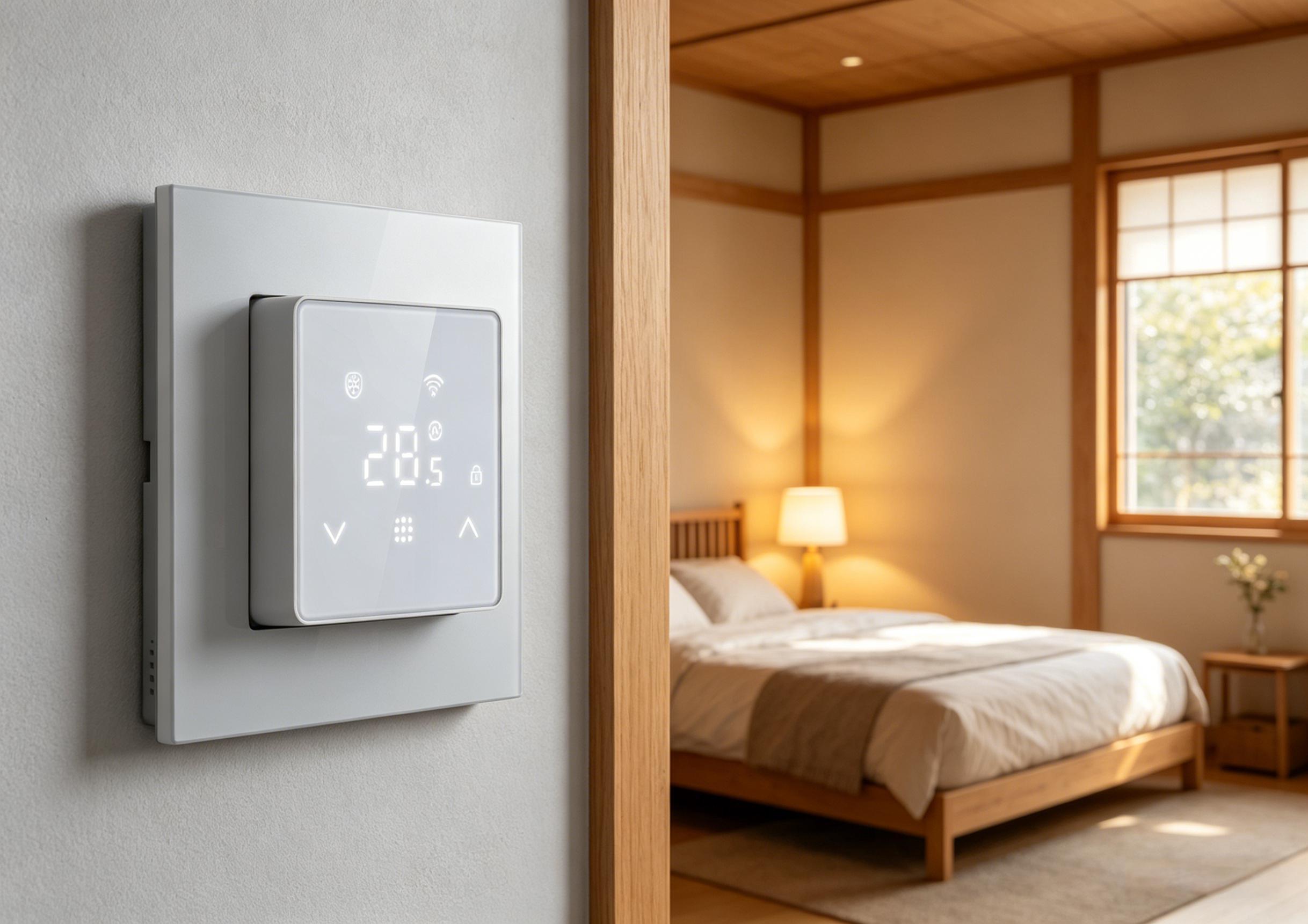
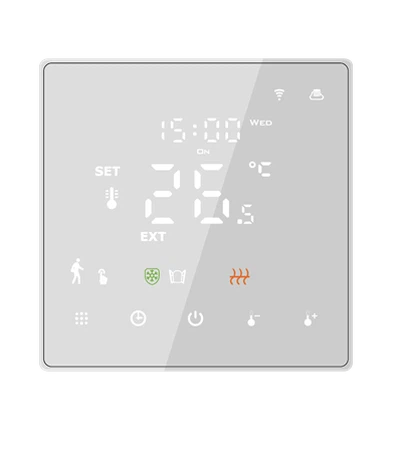
Global Export Guide: Key Voltage & Frequency Compatibility Notes for Smart Thermostats
Leave a message
Introduction
As smart HVAC thermostats become essential for residential, commercial and industrial climate control worldwide, cross-border export requires strict attention to regional power grid differences. Voltage and frequency incompatibility will directly cause thermostat malfunction, component burnout, unstable operation and even safety hazards. For HVAC distributors, contractors and global buyers, selecting fully power-adaptive smart thermostats is the core premise of stable long-term operation. This article analyzes key power adaptation points for smart thermostats exported to different countries and regions, and introduces professional power design advantages of our products.
1. Global Mainstream Voltage & Frequency Standards Overview
The world's power supply systems are mainly divided into two core specifications, forming obvious regional differentiation:
100-127V / 60Hz System: Mainly applied in North America, most South American countries, Japan and parts of Southeast Asia. This low-voltage & high-frequency standard focuses on household power safety, matching local HVAC terminal equipment design.
220-240V / 50Hz System: Dominated in Europe, UK, Australia, most of Asia, Africa and Oceania. High-voltage and low-frequency design features higher energy transmission efficiency, widely used in buildings and central HVAC systems.
In addition, a small number of regions have hybrid power grids and voltage fluctuation problems, which put forward higher requirements for the wide-voltage adaptation and anti-fluctuation ability of smart thermostats.
2. Core Risks of Mismatched Voltage & Frequency for Thermostats
Unmatched power parameters will bring multiple hidden dangers to smart thermostats and supporting HVAC systems:
Hardware Damage: Long-term use of overvoltage or undervoltage will burn internal circuits, relay modules, Wi-Fi communication components and touch control panels, shortening service life greatly.
Functional Failure: Frequency mismatch leads to inaccurate temperature sensing, delayed switch signal output, abnormal linkage of electric valves and air dampers, and poor overall HVAC control effect.
Certification & Compliance Barriers: Non-compliant power design cannot pass local CE, RoHS, UL and other electrical safety certifications, resulting in customs detention and sales restrictions.
Safety Accidents: Unstable power operation may cause short circuit, heat generation, and bring potential fire risks to wall-mounted electrical equipment.
3. Key Adaptation Requirements for Exporting to Different Regions
North & South America Market
Adopt 110V-120V 60Hz standard. Thermostats need to support narrow-band low-voltage input, and the internal power module must adapt to 60Hz frequency operation to ensure the stable work of cooling and heating cycle control.
Europe, Middle East & Africa Market
Unified 220V-230V 50Hz mainstream power supply. Products need to meet EU low-voltage directives, with over-current and over-voltage protection, adapting to complex power environment in remote areas.
Australia & Oceania Market
230V 50Hz power standard, with strict electrical safety and electromagnetic compatibility requirements. The thermostat's power anti-interference design must meet local industry standards.
Global Universal Scenario
For customers with multi-region procurement and mixed project deployment, wide voltage design (110V-240V AC universal) is the optimal solution, which can effectively reduce procurement costs and after-sales maintenance problems caused by model differentiation.
4. Our Professional Power Adaptation Advantages for Global Export
To solve global power adaptation pain points, our smart thermostats adopt industrial-grade optimized design:
Wide Voltage Universal Input: Support 110V-240V AC 50/60Hz dual-frequency automatic adaptation, covering almost all national power standards in the world, one model for global sales.
Built-in Multi-layer Protection: Equipped with overvoltage, undervoltage, overcurrent and surge protection modules, resisting grid voltage fluctuations and ensuring stable operation in complex power environments.
Diversified Power Specification Customization: Support 24V AC/DC low-voltage model customization, matching central air conditioning, floor heating, boiler and heat pump system needs of different projects.
Full Certification Compliance: All products pass CE, RoHS, and other international certifications, fully meeting local electrical access standards for smooth customs clearance and market sales.
Low Power Consumption Design: Optimized power circuit, ultra-low standby power consumption, meeting global energy-saving and emission reduction requirements, helping end users reduce energy costs.
5. Summary
Voltage and frequency adaptation is a key link that cannot be ignored in the export of smart thermostats. Reasonable matching of regional power standards, optimizing product power design, and improving safety compatibility are crucial to market competitiveness.
Our series of smart HVAC thermostats rely on mature wide-voltage dual-frequency technology, perfect safety protection and global certification system, to provide one-stop power adaptation solutions for global distributors, engineering contractors and end customers. Whether it is household heating and cooling, commercial central air conditioning or industrial HVAC control, we can provide customized power specification products to meet diversified market demands.