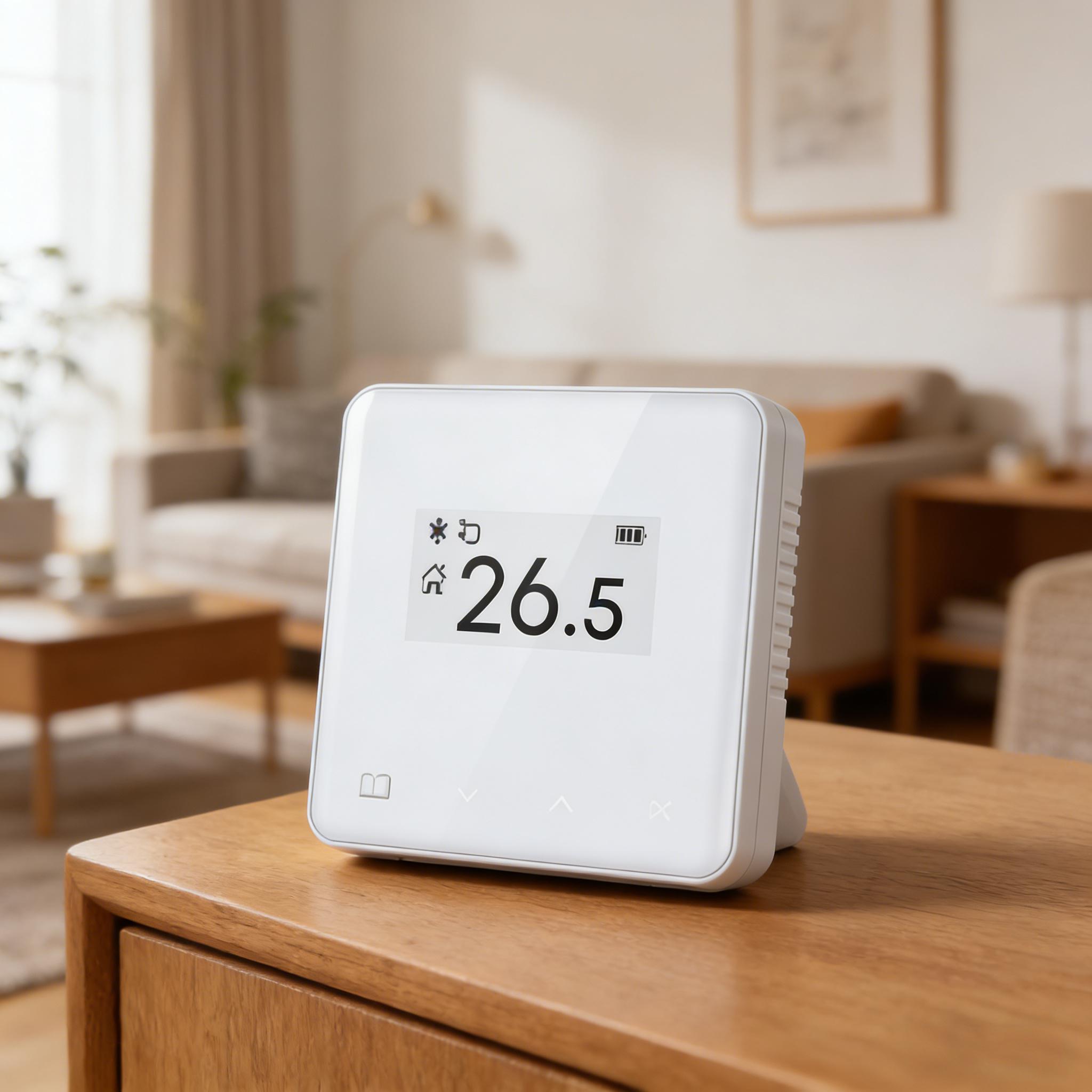
Does Wire Length Affect Signal Reliability in Wired Smart Thermostats?
Leave a message
When installing a wired smart thermostat for residential or commercial HVAC systems, many users overlook a critical detail: the length of signal wires directly impacts signal stability, temperature reading accuracy, and long-term system efficiency . Even a high-end smart thermostat may suffer delayed responses, inaccurate temperature feedback, or intermittent communication failures if wire runs are improperly extended. Understanding how wire length influences signals and mastering installation best practices helps you maximize your thermostat's performance lifespan.
Why Wire Length Disrupts Thermostat Signals
Wired thermostats transmit low-voltage control signals and temperature sensor data through copper wires. As wire length increases, three core electrical issues emerge:
Rising Line Resistance & Voltage Drop: Copper wire resistance grows linearly with length. Excess resistance causes voltage attenuation, weakening control signals and preventing the HVAC unit from executing startup/shutdown commands promptly . long wires alter baseline resistance, leading to static temperature measurement deviations .
Electromagnetic Interference Amplification: Extended signal wires act like "antennas," easily picking up interference from nearby high-voltage cables, motors, or electrical appliances. This distorts digital communication signals and triggers erratic thermostat data display .
Signal Delay & Data Loss: Long cables increase capacitance and inductance, slowing signal transmission. In smart digital thermostat systems, this causes communication lag, frequent disconnections, or failed parameter synchronization .
Practical tests show that ultra-long unoptimized wire runs can introduce temperature errors of ±0.3–0.7°C, directly leading to energy waste and reduced comfort .
Practical Length Guidelines for Wired Thermostat Signal Wires
Not all wire lengths cause problems-following industry standard limits ensures stable signals:
Ordinary 22 AWG (0.33mm²) signal wires: Recommended maximum run ≤100ft (30m); exceeding this requires wire gauge upgrade .
18 AWG (0.75mm²) stranded thermostat dedicated wires: Ideal for 100–250ft (30–75m) medium-long distance installation, balancing resistance and flexibility .
Ultra-long runs >300ft (90m): Use 16 AWG thickened shielded twisted pairs to suppress resistance and interference .
Remote temperature matching sensors: Avoid exceeding 300m maximum recommended length to prevent persistent accuracy drift .
5 Installation Tips to Eliminate Length-Related Signal Failures
Match Wire Gauge to Length Priority: Short runs (<30m) use standard 22 AWG stranded wires; medium-long runs switch to 18 AWG; never use thin solid-core household wires for long-distance wiring (prone to fracture and resistance surge) .
Isolate Wiring to Avoid Interference: Route thermostat signal wires separately from high-voltage power cables; maintain ≥6-inch spacing, and cross power lines at 90° if necessary to reduce induced noise .
Standardize Unused Wire Processing: For multi-core cables with redundant wires, bundle and fix idle wires with wire nuts at both ends-do not leave them exposed to avoid electromagnetic coupling interference .
Optimize for High-Interference Environments: In factories or complex electrical spaces, deploy single-point grounded shielded twisted pairs to block external magnetic and electric field interference .
Pre-Installation Resistance Testing: Use a multimeter to check line resistance before power-on; ensure total loop resistance <2.5Ω to meet thermostat signal load requirements .
Choose Reliable Wired Smart Thermostats to Resolve Wiring Pain Points
A high-quality wired smart thermostat inherently optimizes signal adaptability. Our wired smart thermostats feature:
Wide resistance tolerance design, compatible with 0–80m conventional wire runs, reducing sensitivity to minor length overruns;
Built-in signal anti-jamming filter module, suppressing long-line clutter interference and maintaining ±0.1°C precise temperature control;
Standard terminal adaptation, supporting 16–22 AWG multi-gauge wire access for flexible on-site wiring layout.
Final Takeaway
Wire length is not a trivial installation detail-it is a key factor determining wired smart thermostat signal stability and control accuracy. Reasonably limiting wire run distances, matching appropriate wire gauges, and standardizing anti-interference wiring can completely avoid signal delay, inaccurate temperature reading, and intermittent faults.
Upgrade to our high anti-jamming wired smart thermostat to enjoy stable long-distance signal transmission, energy-efficient HVAC operation, and hassle-free long-term use. Contact our team now for customized wiring technical support and product selection solutions.